 Jinmai Plastic

Choose corrugated plastic box handles by checking the loaded box, the way it will be moved, and the space available for a hand inside and outside the wall. Compare a die-cut hand hole, an opening with a fitted grip or reinforcement, and an attached handle or strap. Specify the opening, position, attachment and any reinforcement on the drawing, then review the complete sample with its contents and dividers. Sheet thickness or a handle’s appearance alone does not establish a carrying capacity.
A box can fit the product perfectly and still be awkward to pick up. A divider may sit behind the hand hole, a lid may cover the grip, or an attached handle may prevent empty boxes from folding flat. These are useful questions to settle while requesting a quotation, before the handle becomes a fixed detail in the cutting layout.
Compare the handle arrangements
The three arrangements below are starting points for a design discussion. Availability and suitability depend on the specific box.
| Arrangement | What it changes | What to check on the sample |
|---|---|---|
| Die-cut hand hole | Forms the grip opening directly in the box wall, without a separate handle component | Opening size, cut-edge finish, finger clearance and the wall around the opening |
| Hand hole with a fitted grip or reinforcement | Adds a component or supporting detail around the opening | Remaining clear opening, fit to the wall thickness, retention and interference with the contents |
| Attached handle or webbing strap | Provides a grip outside the wall through a separate component and attachment | Attachment layout, backing, projection, strap position and clearance when folding or stacking |
These are established packaging approaches. For example, Kiva Container’s box-style information lists die-cut hand openings and applied handles, including plastic, webbing and rope configurations. This confirms the range of possible designs; it does not establish which arrangement or load rating applies to a Jinmai order.
Jinmai’s corrugated plastic box product lists handles among its customization options. Start with the intended use, then ask which construction can be supplied and reviewed for that project.
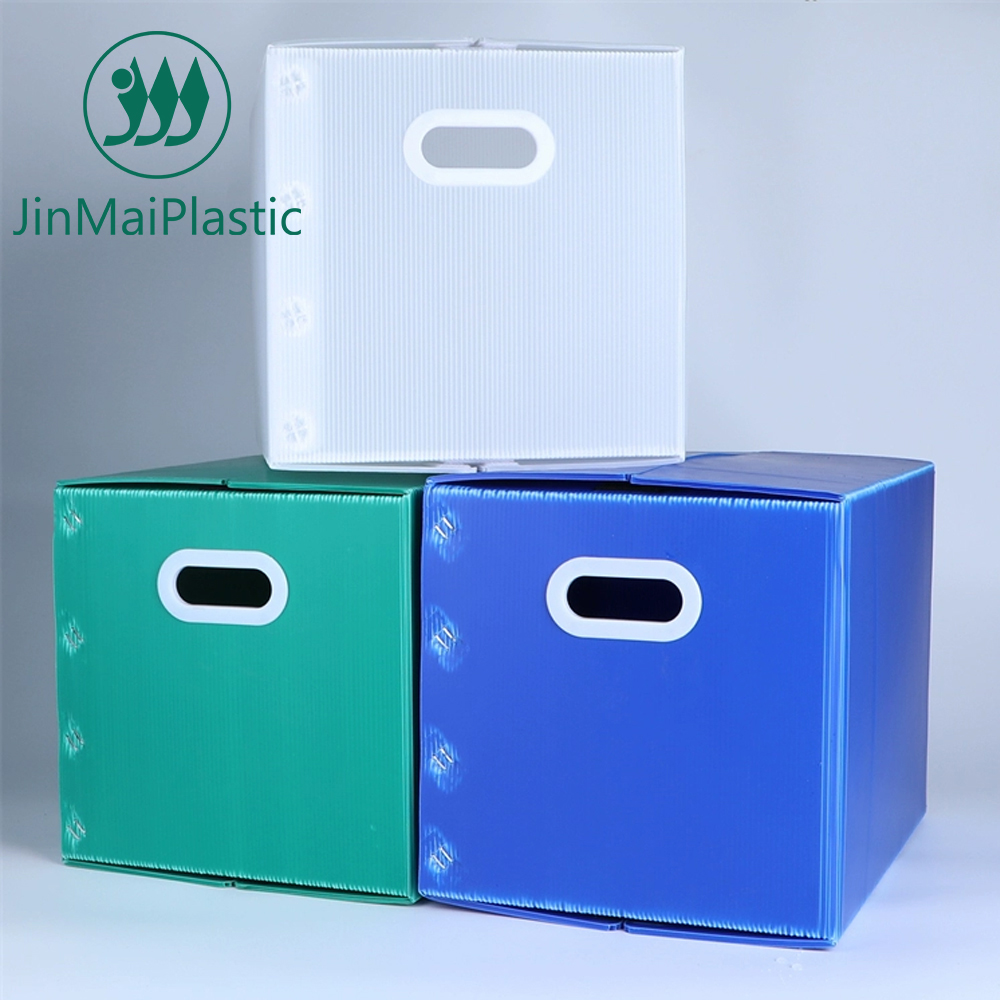
An existing Jinmai product-gallery example with oval grip inserts. The photograph shows the arrangement, not a load rating or the attachment details behind the wall.
Describe how the box will be moved
Tell the supplier whether the handles will be used on an empty box, a partly filled box or a fully loaded box. Give the total loaded mass, including the box, lid, dividers and other packaging, as well as the product weight.
Describe the actual pickup and set-down points. A box transferred between two benches presents a different access problem from one taken out of a close-fitting shelf. State which sides are accessible and whether gloves are worn. If the process uses a trolley, conveyor or other handling equipment, show the contact points and any restrictions on projecting parts.
Handle position should follow that process. Primex’s nestable tote, for example, has handles on both short sides. That is one product configuration, not a rule that every custom box should follow.
Do not describe a hand grip as a hoist point or assume it is suitable for dragging a loaded box. Identify any such requirement separately for engineering review. The buyer’s workplace handling procedure should govern how people move the container.
Put the opening and its surroundings on the drawing
“Add two handles” leaves several important choices unresolved. Include the following details in the drawing or quotation brief:
| Detail | Information to provide |
|---|---|
| Handle sides | Identify the panels and the upright orientation of the assembled box |
| Clear opening | Required usable width and height after any grip insert is fitted |
| Position | Dimensions from named drawing references, such as the finished top edge and a side edge |
| Opening shape | Cut profile, corner treatment and edge-finish requirement |
| Wall construction | Material grade, thickness, sheet weight, flute direction and any doubled section |
| Reinforcement or attachment | Proposed insert, backing, fasteners, strap anchorage or other supporting detail |
| Inside clearance | Space behind the opening with the product, dividers and lining installed |
| Outside clearance | Projection relative to the lid, adjacent boxes, rack and folded return pack |
Distinguish the cutout size from the usable grip opening. An insert can occupy part of the opening, so a hole measured before assembly may not represent the space available to the hand afterward.
Likewise, keep hole position separate from box size. Use the drawing and tolerance guide to define the controlling units, measurement references and agreed tolerances. Avoid measuring a grip from an unscaled product photograph.
Review the handle, wall and box together
A separate handle component is only one part of the construction. Its attachment, the surrounding wall and the rest of the assembled box also need to work in the intended handling condition.
Ask the supplier to identify how the proposed grip is retained and where support is added. Where attachments project inside the box, check their distance from the product and divider cells. Where reinforcement is proposed, record its material, dimensions and fixing method rather than approving the word “reinforced” alone.
For context, Dou Yee’s corrugated-box catalogue presents handles and perimeter reinforcement as separate configurable features. Its component specifications belong to its own products and should not be transferred to another supplier’s box.
Treat carrying, stacking and shipping as separate requirements. A sample that performs acceptably when supported underneath has not, by that fact alone, demonstrated its performance when lifted through the side grips. Define the required sample evaluation with the supplier; use the box load-capacity guide for the broader loading and test conditions.
Check dividers, lids and the folded position
Handle clearance is a three-dimensional issue. Looking at a flat cutting drawing is useful, but the assembled contents can occupy space that appears empty on the box outline.
Example: a divided parts box. Suppose an existing divider layout places the outer row of parts immediately behind the proposed hand holes. The empty sample allows a comfortable grip, but the loaded layout leaves no space for gloved fingers. Adding a grip insert would not create that missing internal space.
Possible revisions to discuss include moving the opening, changing the divider setback or considering an external grip arrangement. Each changes a different part of the package. Compare usable internal space, outside dimensions and attachment requirements before selecting a revision. This is a design example, not a tested Jinmai configuration.
For a foldable corrugated plastic box, review the complete fold-and-open sequence as well. Check whether straps become trapped, rigid grips collide with another panel, or an added component changes the height of the flat return pack. Try the lid and any removable dividers in the same configuration intended for use.
Use a sample review that matches the intended configuration
Agree on the review conditions and acceptance criteria before evaluating the sample. A practical sequence is:
- Identify the sample. Record the box drawing, material, handle component and attachment revisions.
- Check the dimensions. Measure the finished opening and handle position after assembly.
- Install the contents. Fit the actual dividers, lining and lid, with the agreed representative contents.
- Review access. Check the intended grip and glove clearance at the pickup and set-down locations.
- Complete the agreed evaluation. Use the defined loading, handling and repetition conditions with appropriate personnel. Record wall distortion, movement of attachments, damage and loss of function.
- Record the decision. Keep photographs, observations, unresolved conditions and the approved revision together.
There is no universal grip size, carrying weight or cycle count supplied by this checklist. These values belong in the project specification. A later change to the box wall, handle, fastener, divider or loading arrangement should trigger a review of whether the earlier approval still applies.
A handle specification checklist for your RFQ
Use this short brief when requesting options or comparing quotations:
| RFQ item | Buyer input |
|---|---|
| Box and part | Drawing revision, internal dimensions and photos of the packed product |
| Weight and arrangement | Product weight, total loaded mass and how the contents are distributed |
| Handling route | Pickup/set-down positions, accessible sides and equipment used |
| Grip requirement | Preferred arrangement, glove use, clear opening and handle position |
| Construction | Proposed wall, insert, reinforcement and attachment details |
| Clearance | Product/divider setback, lid operation and permitted outside projection |
| Return condition | Assembled, nested or folded; packing arrangement for empty returns |
| Approval basis | Sample configuration, evaluation method, acceptance criteria and responsible reviewer |
Ask suppliers to specify the handle and attachment included in each quote. A price for a bare die-cut hole is not directly comparable with a price that includes a grip insert, backing and assembly. Record any exclusions and unresolved details before comparing the totals.
Download the handle specification checklist
Download the corrugated plastic box handle RFQ checklist (CSV)
Use the 24-item worksheet to record buyer requirements, supplier confirmation and approval evidence. It leaves dimensions, materials and acceptance criteria open for your actual project.
Frequently asked questions
Are die-cut hand holes always the lowest-cost option?
They avoid a separate handle component, but total cost still depends on tooling, cutting, wall construction, reinforcement, assembly and quantity. Compare quotations for an agreed finished specification rather than assuming one arrangement is always cheaper.
Does a plastic grip insert increase the box’s carrying capacity?
A grip insert may change the contact surface and opening construction, but its presence does not establish a higher carrying capacity. Review its retention, the surrounding wall and the complete loaded box under the agreed conditions.
Can handles be added to a foldable PP box?
They can be considered as part of the design. Jinmai lists handles as optional accessories for foldable boxes, subject to review. Check clearance during folding, reopening, packing and use before approving the arrangement.
Should the hand holes be on the short sides?
Not automatically. Choose the accessible sides for the intended process, considering the loaded arrangement, shelf or equipment access, lid and contents. Show the selected panels on the drawing rather than relying on the terms “front” and “side” alone.
Can I choose the handle from a product photo?
A photograph can communicate the preferred appearance. It cannot reliably show the clear opening, wall thickness, backside retention, reinforcement or load performance. Request the proposed drawing and sample details for the actual box.
What changes for an ESD packaging project?
List the handle, attachments and any lining in the packaging specification so they can be reviewed with the rest of the assembly. Do not infer an accessory’s electrical properties from its color or assume the box sheet’s specification applies to every component. Refer to the ESD packaging specification guide when preparing that brief.
Discuss a handle arrangement with Jinmai
Send the completed handle specification brief and a photo or drawing of the loaded layout. Jinmai can review handle options with the proposed corrugated plastic box design and confirm the quotation and sample requirements.
Request a quote for a custom corrugated plastic box. Include the checklist above in the message; use the contact email shown on the site for drawings or photos if the form does not offer an attachment field.