 Jinmai Plastic

Inspect incoming corrugated plastic boxes against the approved drawing, sample and purchase order. Confirm the lot and revision first, then check dimensions, sheet specifications, cuts, joints, accessories, dividers, labels and cleanliness. Record actual findings and apply the agreed sampling and release rules. A visual pass alone does not establish load capacity or service life.
A custom box can look right on the pallet and still arrive with the wrong divider layout, an inward-facing fastener or an outdated label. Receiving inspection connects the design you approved to the boxes you actually received.
This checklist covers new polypropylene (PP) hollow-sheet boxes, also called corrugated plastic boxes or Coroplast-style boxes. Use it for incoming orders after the design has been approved. Inspections between reuse cycles need a separate cleaning, damage and retirement procedure.
Download the receiving inspection log (CSV)
Before opening the delivery: establish the reference
Put these records beside the inspection station:
- Purchase order, item code, quantity and supplier lot identification.
- Approved drawing revision, sample ID, photographs and any authorized change notice.
- Written dimensions, tolerances, material requirements and workmanship criteria.
- Inspection plan, required reports and the person authorized to release the lot.
Resolve contradictory references before judging the shipment. If a drawing specifies one closure and the retained sample has another, the inspector needs an agreed reference. A signature on an unidentified sample is not enough to explain which revision it represents.
For dimensions and measurement points that should be established before production, see the corrugated plastic box drawing and tolerance guide.
The 12-point corrugated plastic box inspection checklist
Use the following checks to build an order-specific receiving plan. The table names what to inspect; your approved specification supplies the limits and acceptance rules. Record “not applicable” with a reason where a feature is absent.
| Check | What to examine | What to record |
|---|---|---|
| 1. Item, lot and revision | Box code, supplier lot, drawing/sample revision and approved changes | PO, lot ID, revision and any mismatch |
| 2. Quantity and packing condition | Box and accessory counts, pallet/carton identification, crushed or punctured packs | Count, affected pack IDs and arrival photographs |
| 3. Finished dimensions | Inside and outside dimensions, height and critical openings in the specified assembled state | Actual readings, units, measuring points and tool ID |
| 4. Sheet specification | Specified grade, thickness, color, flute direction and GSM where required | Supplier records and measurements using the agreed methods |
| 5. Cuts, creases and edges | Slots, hand holes, fold locations, damaged edges and loose cutting debris | Feature location, observation and defect-reference photo |
| 6. Joints and fasteners | Joint type and position, attachment count, visible gaps, missing or loose hardware, protrusions | Inside/outside views and results of specified checks |
| 7. Handles, lids and closures | Correct components, orientation, attachment and operation | Fit/function observations and component identification |
| 8. Dividers and inserts | Cell count, usable clearance, height, orientation and seating | Actual dimensions, sample-part fit and missing components |
| 9. Assembly and operational fit | Erection, closing, folding or nesting where specified; fit with the intended fixture or mating box | Defined setup, observations and any interference |
| 10. Print and identification | Artwork revision, text, label placement and barcode/QR function where required | Proof reference, scan result and label photograph |
| 11. Cleanliness and condition | Loose particles, oil, residue, damage and other conditions covered by the order | Findings, locations and required follow-up |
| 12. Required evidence and release | Order-required inspection/test records, outstanding deviations and authorized disposition | Report references, release/hold decision, name and date |
Check 2 starts at the delivery level. Checks on individual boxes follow the agreed sampling plan. Check 12 closes the lot record; it is not an extra box to sample.
Photograph arrival damage before repacking. Keep observations separate from conclusions about its cause: a crushed corner is evidence of damage, but the photograph alone may not establish when it happened. Photographs support the record; they do not replace specified measurements or establish the condition of uninspected boxes.
Measure the box in the condition stated on the drawing
Specify whether a dimension applies to the flat blank, erected empty box, closed box or installed divider assembly. Place the box on the agreed support surface and measure between the defined points. Do not squeeze or stretch it to obtain a passing reading.
Record the actual value and unit instead of writing only “OK.” If the drawing uses millimeters, retain the millimeter acceptance limits. A rounded inch conversion should not become a second, conflicting tolerance.
Illustrative example, not a Jinmai tolerance: an approved inside dimension of 500 ± 3 mm has limits of 497–503 mm. A reading of 498 mm is inside that range. It does not settle whether a divider, fastener or lid reduces the usable space at another location. Check those features against their own criteria and complete the specified part-fit check.
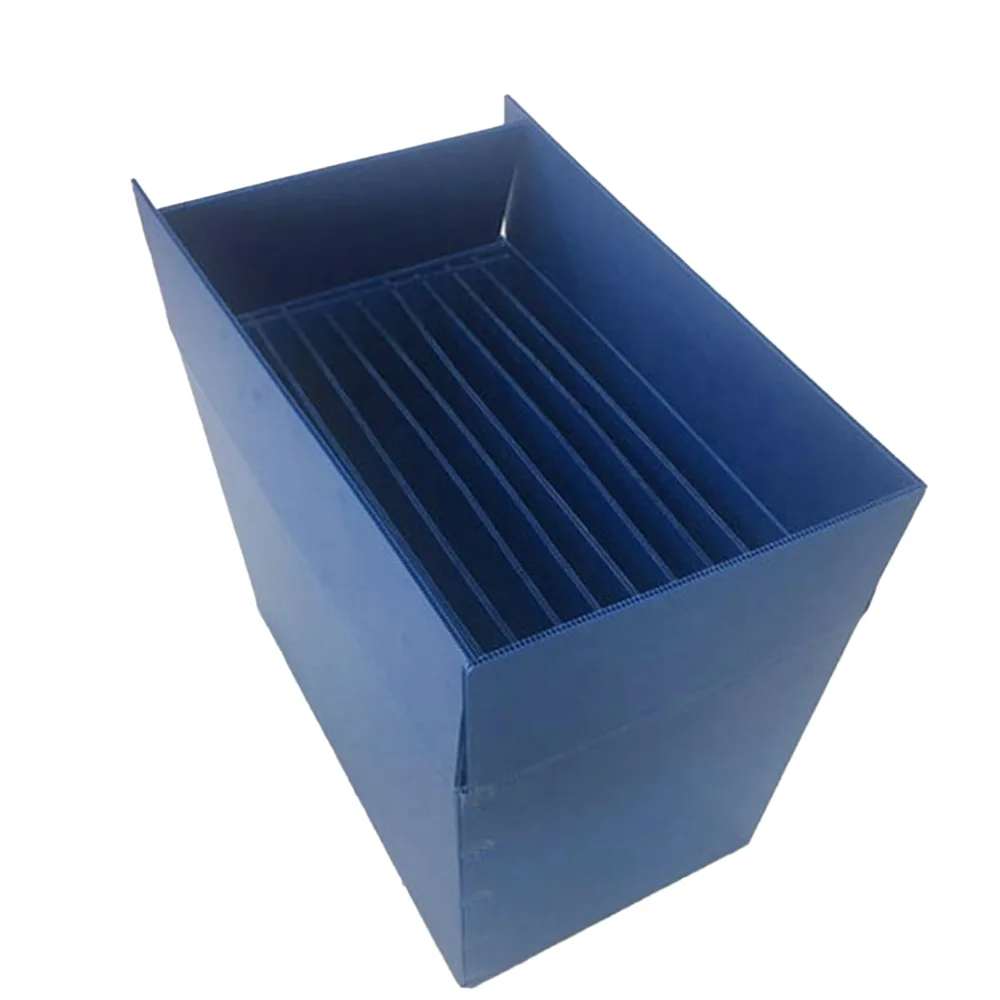
For boxes with dividers, inspect usable cell space with the insert installed. A loose insert measured on a bench may not reveal how it seats inside the finished box. Use an approved sample part or gauge where the inspection plan calls for one, and record its identity.
Keep thickness, GSM and box weight separate
Use the agreed instrument, measuring locations and measurement conditions for sheet thickness. Record contact pressure if the chosen method controls it. Define how many points to measure and how readings are assessed; do not invent a tolerance at the receiving dock.
GSM means grams per square meter of sheet. If the order requires a GSM check, define the sheet specimen and method in advance. Weighing a complete box also includes its joints, handles, lids and inserts, so complete-box weight is a different check. The PP sheet weight calculator explains the relationship between sheet area, GSM and mass.
Visible color and thickness cannot confirm every material requirement. Where the order specifies a material grade or functional property, match the required supplier documentation and test evidence to the item and lot.
Inspect joints and closures from both sides
Open the box and look inside as well as outside. Compare joint positions, attachment details and closure components with the approved reference. Note a missing fastener, a loose attachment, an unexpected projection into the product space or a visible opening at the joint.
If the joint construction is still being selected, review welded and riveted PP box joints before approving the reference sample. The comparison worksheet helps record the joint details that receiving inspection will later check.
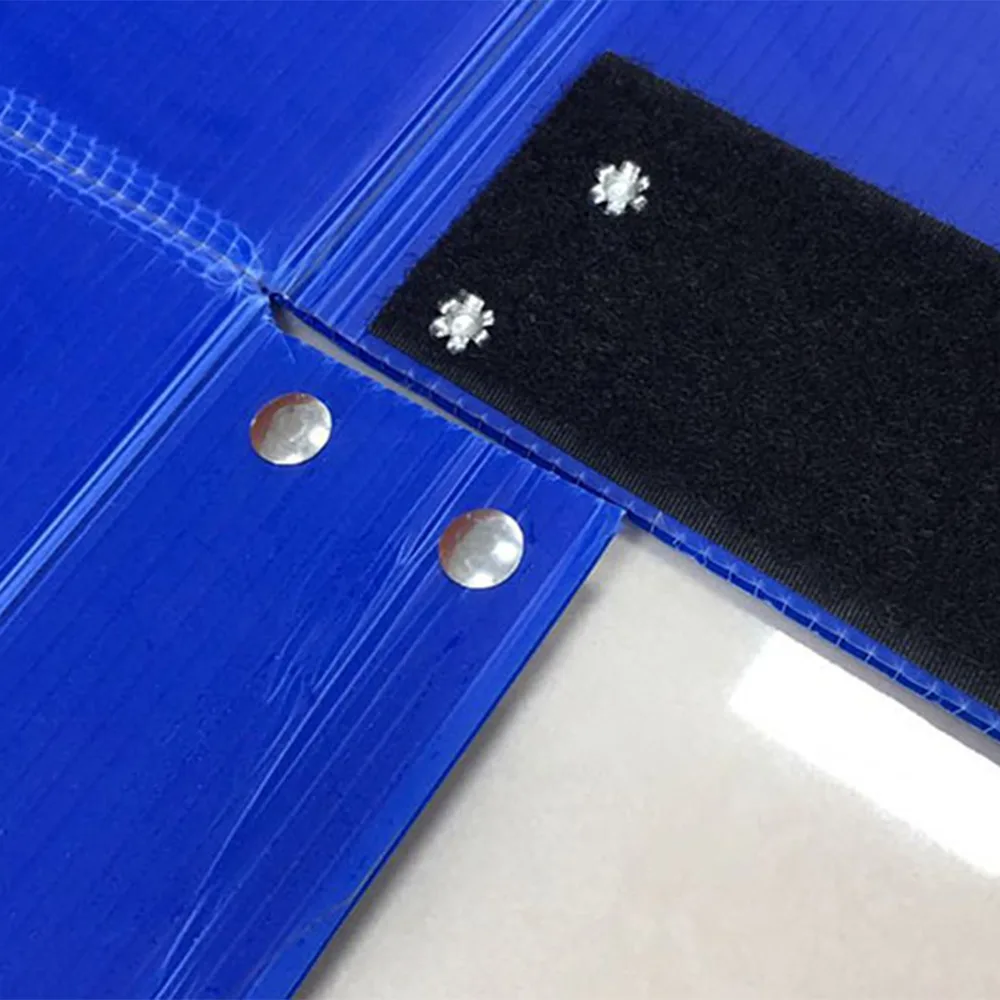
This Jinmai sample photograph shows blue panels, metal fasteners and a black strip. It helps locate features to inspect. It is not a defect-limit photograph or a joint-strength test result.
For welded areas, use the agreed visual criteria and any specified functional test. Appearance alone cannot establish the strength of a weld. For a handle or lid, complete the approved fit/function check; do not substitute an improvised loaded lift for a defined test procedure.
Receiving checks should confirm the ordered construction. Design qualification addresses whether that construction can perform on the route. Use the separate box load-capacity test checklist when specifying payload, support, stacking, handling and environmental tests.
How many boxes should you inspect?
Use the sampling plan agreed for the order. There is no universal sample size or AQL for all corrugated plastic boxes. The lot definition, risks, defect categories and supplier history affect the plan the buyer’s quality team chooses.
NIST describes acceptance sampling as randomly selecting units to support an accept-or-reject decision about a lot. It distinguishes this decision from estimating the lot’s actual quality level. See NIST’s introduction to acceptance sampling.
If the contract uses ISO 2859-1:2026, identify the edition and use the applicable AQL-indexed inspection scheme. Before inspection, document:
- The defined lot, its size and how units will be randomly selected.
- Defect categories, inspection level, AQL and counting basis.
- The selected plan, sample size and applicable acceptance/rejection numbers, often written Ac/Re, matched to each defect category where separate plans apply.
- The inspection status and switching rules, supported by the required lot history.
- Separate checks for documents, critical characteristics or tests outside that sampling plan.
Do not select only the easiest boxes to reach. Follow the agreed random selection method across the defined lot, with access to the relevant pallets and packs. Identify mixed lots before sampling rather than silently combining them.
AQL is not a promise that every accepted delivery contains fewer than a stated percentage of defective boxes. Sampling involves both producer and consumer risk, as explained in NIST’s acceptance-plan terminology. Even a plan accepting zero observed defects does not prove that the entire lot has zero defects.
Define defects before deciding whether the lot passes
“Poor finish” is difficult for a supplier and buyer to resolve. “Loose metal fastener inside the product compartment, photo 04, criterion J-02” identifies a condition that can be reviewed.
Use the categories below as a starting point for agreement, not an automatic classification of every defect.
| Category | How to define it for the order | Possible example to assess |
|---|---|---|
| Critical | A condition creating an unacceptable safety or other project-defined critical risk | A hazardous sharp projection in the operator’s grip area |
| Major | A condition likely to prevent the intended fit, handling or product-protection function | A divider arrangement that prevents loading the approved part |
| Minor | A departure from agreed appearance/workmanship without the specified functional impact | A cosmetic mark outside the product-contact area that exceeds the agreed visual limit |
The same observation can have different consequences in different applications. A misplaced label may be cosmetic in one process and prevent identification in another. Decide its category from the intended use and agreed defect definitions.
Also state whether the plan counts nonconforming units or individual nonconformities. A box with three defects is one nonconforming box but may have three recorded nonconformities. Preserve the observations and apply the selected counting rule consistently.
Do cardboard-box requirements apply to PP boxes?
Check the scope before copying a paper-carton specification. For example, ASTM D5639/D5639M-25 addresses corrugated fiberboard materials and box construction. It is not a PP hollow-sheet acceptance specification. Any proposed test and limit must suit the ordered material, finished package and intended use.
What to do when something fails or evidence is missing
Keep the affected stock identified and on hold while the authorized team determines the next step. A missing required report is an unresolved release condition; do not invent a passing result to complete the form.
- Contain: identify the affected lot, pack IDs and quantities. Prevent accidental issue to production.
- Record: retain measurements, sample IDs, photographs and the exact requirement involved.
- Review: notify the supplier through the agreed process and assess whether other stock may be affected.
- Decide: document rejection, replacement, authorized sorting/rework or a formally approved deviation, as appropriate.
- Verify and close: reinspect under an authorized plan where required, retain the original failure record and record the final disposition.
Do not keep drawing extra samples until a failed lot appears to pass. Any additional sampling must follow the selected plan or a documented, authorized investigation and reinspection process.
Download the receiving inspection log
Download the receiving inspection log (CSV)
The CSV opens in Excel or Google Sheets. It includes the 12 check areas plus columns for PO, lot, sample or pack ID, requirement reference, acceptance criterion, method/tool, actual result, defect classification, evidence and reviewer.
Use a delivery or lot identifier for the delivery-level checks. Duplicate the relevant box-check rows for each sampled box, and add rows where a check contains several measured characteristics. Fill in criteria before recording results. Blank criteria and blank results are not passes.
Retain a lot summary alongside the log: inspected quantity, counting basis, counts by category, plan/Ac-Re reference, required evidence, unresolved issues and the authorized release or hold decision. The file contains no preset AQL, dimensional tolerance or automatic release formula.
Buyer questions
Does an approved sample replace a drawing?
Use them together. A sample can show construction, finish and operation; a controlled drawing states dimensions, tolerances and revision. If they conflict, resolve the discrepancy before acceptance.
Can the supplier’s inspection report replace incoming inspection?
It can provide evidence within the buyer’s agreed control plan. Check that it identifies the delivered item and lot, the relevant specification, methods and results. The buyer’s approved procedure determines whether additional receiving checks are required.
Does a visual inspection confirm the load rating?
No. Visual inspection can reveal damage or differences from the approved design. Load and stacking performance require evidence for the specified box construction, support, load, duration and environment.
Is a black PP box automatically ESD-safe?
No. Color does not establish electrostatic properties. Match the required material and test records to the agreed ESD packaging specification and its intended application.
What if different lots arrive on one pallet?
Identify which units belong to each lot and apply the agreed plan to those defined lots. If the identification cannot be resolved, hold the affected stock until traceability and the inspection approach are agreed.
When inspecting fold-flat return boxes or totes with internal partitions, compare the pre-production sample with the approved drawing. For a custom foldable corrugated plastic box with corrugated plastic divider inserts, check smooth folding along the creases, fastener and seam details, and the usable internal dimensions with the dividers fitted.
Align the inspection points before placing the order
Jinmai offers custom corrugated plastic boxes with options such as lids, handles and divider inserts. Send the approved drawing or current proposal, intended use and receiving requirements when discussing a new order. Ask which material records, checks and reports can be supplied for the specific project.
If the inspection points are part of a new box sourcing decision, browse the corrugated plastic box category before sending the approved drawing and receiving requirements.
The most useful inspection checklist is one the buyer and manufacturer can apply to the same box and reach the same conclusion. Agree on measurable requirements, identified references and release responsibilities before production begins.
Discuss custom box and receiving-inspection requirements
Prepared by the Jinmai Plastic Editorial Team. Standards references checked October 14, 2026. The photographs show product construction; this guide does not report a tested load rating or a completed lot inspection.