 Jinmai Plastic

Anti-static and conductive PP hollow sheet are not interchangeable descriptions. “Anti-static” is often used loosely for low-charging or static-control material, while conductive and static-dissipative describe resistance-related properties. Lower resistance is not automatically better for every ESD packaging application. The correct choice depends on the ESD-sensitive item, direct-contact surfaces, the ESD protected area (EPA), grounding conditions, the complete handling route and the buyer’s specified test method.
This guide explains how to compare the material functions and what evidence to request before approving an ESD corrugated plastic sheet, divider or reusable box. It does not replace the buyer’s ESD control plan or a qualified ESD professional’s application-specific decision.
Key Takeaways
- Antistatic, low-charging, static-dissipative, conductive and discharge-shielding are different properties.
- A material’s color does not demonstrate its ESD performance.
- Low-charging behavior cannot be inferred from resistance alone.
- A resistance result is incomplete without the test method, electrodes, voltage, conditioning and sample information.
- Packaging used only inside an EPA may need a different protective function from packaging that enters an uncontrolled area.
- The box body, separatoare, layer pads and direct-contact surfaces should be reviewed separately.
- A raw-sheet result should not automatically be treated as evidence for every processed part or assembled package.
What Do Anti-Static, Static-Dissipative and Conductive Mean?
The terms describe related but different parts of an ESD-control strategy. Buyers should define the required function instead of using “ESD safe” as the complete specification.
| Term or property | What it means for packaging selection | What it does not prove |
|---|---|---|
| Low-charging / antistatic | The material is intended to limit charge generation when surfaces contact and separate. | It does not, by itself, establish a resistance classification or discharge-shielding performance. |
| Static-dissipative | The material provides an intermediate resistance path that may allow charge to dissipate in a controlled way in the intended system. | It does not prove that the package is correctly grounded or suitable for every ESDS item. |
| Conductiv | The material provides a lower-resistance path for charge movement when used with an appropriate connection or grounding arrangement. | It does not mean that lower resistance is always safer for direct contact with a device. |
| Insulative | Charge does not move away readily enough to avoid accumulation under the relevant conditions. | Ordinary plastic appearance does not reveal the measured classification. |
| Discharge shielding | The package limits energy from an external electrostatic discharge reaching the protected item. | A conductive or lidded box should not automatically be assumed to provide verified discharge shielding. |
The EOS/ESD Association explains that ESD packaging can require three different functions: low charging at contact surfaces, conductive or dissipative resistance behavior, şi – outside an EPA – discharge shielding where required. It also states that low-charging behavior is not necessarily predicted by resistance or resistivity. These distinctions are why a single marketing label or meter reading cannot define the complete package.
Anti-Static vs Conductive PP Hollow Sheet
The practical difference is not simply “weaker” versus “stronger” ESD protection. The materials perform different functions within a defined packaging and grounding system.
| Purchasing question | Antistatic / low-charging | Static-dissipative | Conductiv |
|---|---|---|---|
| Primary selection purpose | Limit charge generation during contact and separation | Allow charge to dissipate through an intended path at a controlled rate | Provide a lower-resistance path for charge movement |
| Is it the same as the other two? | Nu | Nu | Nu |
| Can color prove the property? | Nu | Nu | Nu |
| Is a grounding review needed? | Depends on the complete application | Normally yes, where dissipation relies on a ground path | Normally yes, where charge must move to ground |
| Is one resistance number enough? | Nu | Nu | Nu |
| Minimum purchasing evidence | Defined property, method and relevant test evidence | Target range, method, conditions and relevant test evidence | Target range, method, conditions and relevant test evidence |
The final classification and acceptance limit should come from the buyer’s ESD control program, customer drawing, purchase specification or applicable standard. Jinmai does not recommend selecting a grade by a general resistance range copied from a brochure or another project.
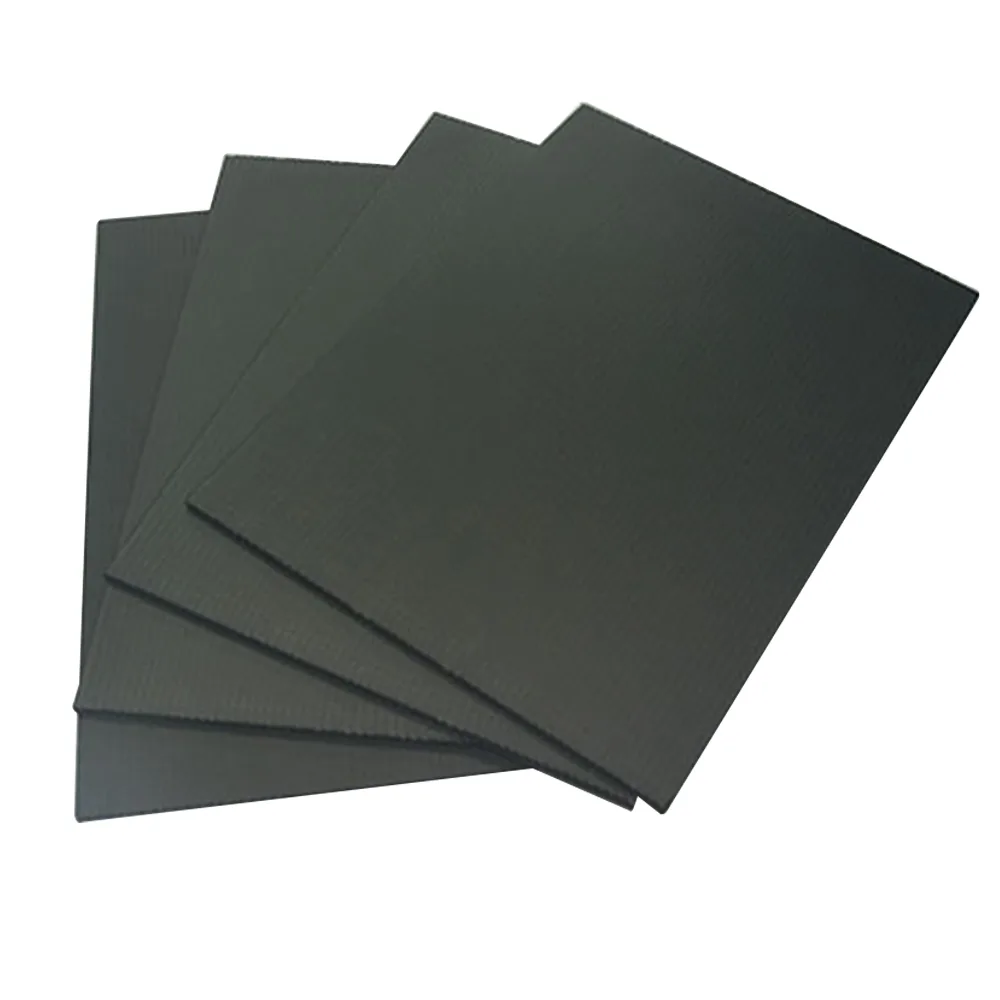
Why Black PP Hollow Sheet Does Not Automatically Mean Conductive
Black is common in some conductive plastic formulations, but color is not a test result. A standard black PP sheet may use pigment without providing the required electrical behavior. Conversely, other colors may be possible depending on the formulation and required property.
Buyers should therefore avoid specifications such as “5 mm black anti-static sheet” unless the following are also defined:
- the required ESD function;
- the acceptance range or performance criterion;
- the test method and conditions;
- whether the requirement applies to the raw sheet, divider, cut component or complete package;
- the evidence required for sample and production approval.
An ESD symbol, warning print or black surface helps identification, but none of these replaces verification.
Why Surface Resistance Is Not the Whole Answer
Surface resistance is useful only when it is measured and interpreted for the intended packaging function. A buyer should also review direct-contact behavior, the package’s location, its ground path, and whether external discharge shielding is required.
Surface resistance and volume resistance are different measurements
ANSI/ESD STM11.11-2022 defines procedures, equipment, sample preparation and conditioning for reproducible surface-resistance measurements of planar materials. IEC 61340-2-3:2016 covers test methods for resistance and resistivity of solid materials used to avoid electrostatic charge accumulation.
A report should state what was measured. Rezistenta la suprafata, surface resistivity, volume resistance, point-to-point resistance and resistance to a groundable point are not interchangeable labels.
The test setup changes the meaning of the result
Electrode geometry, applied voltage, specimen conditioning, umiditate, temperature, contact pressure and test location can affect a resistance measurement. A bare number such as “10⁸ Ω” is not a complete test report.
The finished package may need separate verification
Tăiere, creasing, sudare, fasteners, edge finishing, printed areas, dividers and accessories can change which surfaces touch the ESDS item and whether a continuous charge path exists. Agree in advance whether acceptance applies to the sheet, a processed component or the assembled package.
Packaging Inside and Outside an EPA
An EPA is an ESD protected area in which grounding, personnel, work surfaces, equipment and handling controls are managed together. The packaging decision changes when the handling route crosses an EPA boundary.
| Handling scenario | Questions the buyer should answer |
|---|---|
| Production-line turnover inside one EPA | Which surfaces contact the item? What low-charging and resistance properties are required? How is the container connected to the controlled ground system? |
| Warehouse movement inside a controlled facility | Are storage racks, carts and operators part of the ESD control plan? How will boxes be cleaned, stacked and periodically verified? |
| Movement between separate EPA zones | Does any stage pass through an uncontrolled area? Is the container opened during transfer? |
| Transport outside an EPA | Is discharge shielding required? Does the reusable box need a shielding bag, liner, cover or another protective layer? |
| Export or third-party logistics | Which customer standard, contract requirement, report and traceability record must travel with the shipment? |
IEC 61340-5-3:2022 defines properties and requirements for packaging intended to protect ESD-sensitive devices through production, rework and maintenance, transport and storage. In the United States, ANSI/ESD S541-2026 defines the packaging properties required throughout those stages; the EOS/ESD Association identifies IEC 61340-5-3 as technically equivalent.
These standards establish a framework. The device owner or ESD coordinator should determine the final combination of properties for the actual component and route.
What an ESD Test Report Should Show
A useful report identifies the tested item, method, conditions and actual results. “PASS” without this context is not sufficient for technical approval.
| Report field | What to check | Why it matters |
|---|---|---|
| Material and traceability | Material name, nota, sample ID, lot or batch | Connects the result to the approved and delivered material |
| Test object | Raw sheet, cut divider, component or assembled box | Prevents a sheet result from being misapplied to a complete package |
| Property measured | Low charging, resistance/resistivity or shielding performance | Identifies the function actually evaluated |
| Standard and method | Full method designation and revision | Defines the measurement procedure and equipment |
| Instrument and electrode | Meter, electrode type and applicable calibration information | Supports reproducibility and method suitability |
| Test voltage | Applied voltage and switching rule, where applicable | Resistance measurements can depend on the applied voltage |
| Conditioning | Temperature, relative humidity and conditioning time | Environmental conditions can materially affect results |
| Sampling | Number of specimens, surfaces, directions and test points | Shows whether the result represents more than one convenient point |
| Results | Individual readings, units and summary | Allows the buyer to review spread and consistency |
| Acceptance basis | Required range or criterion and source | Shows why the result was accepted |
| Responsibility and date | Laboratory or internal testing party, reviewer and test date | Establishes accountability and currency |
For small or non-planar packaging components, the selected test method must also suit the geometry. Do not substitute a convenient electrode arrangement without documented technical justification.
Buyer’s ESD Packaging Selection Table
| Product or situation | Priority questions before material selection |
|---|---|
| Bare PCB, IC or exposed electronic device | What is the device sensitivity? Which surfaces make direct contact? Are low-charging and shielding properties required? |
| Connector, sensor or precision module | Are terminals exposed? What divider clearance prevents both contact and movement? Which ESD property applies to the divider? |
| Reusable line-side tote | Is it always inside an EPA? What grounding path and periodic verification are defined? |
| Divider box moving between facilities | Does it leave controlled areas? Is an additional shielding layer required? |
| Packaging exposed to cleaning and repeated handling | Which cleaner, temperature, abrasion and reuse interval apply? When will performance be rechecked? |
| Customer-controlled specification | Which drawing, standard revision, test method, acceptance limit and report format are contractually required? |
ESD Packaging RFQ Checklist
Copy this checklist into an inquiry or purchasing specification. Unknown items can be marked “to be reviewed,” but they should not be silently replaced by a supplier assumption.
| RFQ field | Information to provide |
|---|---|
| Packed product | Product name, model and whether it is an ESDS item |
| Sensitivity and governing requirement | Device sensitivity, customer drawing, ESD control plan or applicable standard |
| Complete handling route | Loading, depozitare, EPA boundaries, transport and unloading |
| Required ESD function | Low charging, dissipative, conductive, shielding or a defined combination |
| Acceptance evidence | Test method, target criterion, sample report, batch report or third-party report |
| Product dimensions | Length × width × height, exposed terminals and contact restrictions |
| Pack quantity and orientation | Pieces per cell, cells per layer, number of layers and removal direction |
| Box dimensions | Required inner size and any outer-size, rack, cart or pallet limit |
| Mechanical load | Weight per part, total box load, stacking height and handling method |
| Structure | Fixed or foldable, open or lidded, divider and layer-pad arrangement |
| PP sheet requirement | Grosime, GSM, color and any approved reference sample |
| Accessories and identification | Handles, label holders, document pockets, Velcro, printing and ESD marking |
| Reuse and cleaning | Expected cycles, cleaning agent, temperature, abrasion and inspection interval |
| Commercial information | Sample quantity, production quantity, destination and target schedule |
| Supporting files | Product drawing, current-packaging photos, loading diagram or physical sample |
Ten questions to answer before requesting a quote
- What product will be packed, and is it classified as an ESDS item?
- Which customer specification, ESD control plan or standard applies?
- Will the product be handled inside an EPA, outside it, or both?
- Which surfaces of the sheet, divider or layer pad will directly contact the product?
- Is low-charging, static-dissipative, conductive or discharge-shielding performance required?
- Which test method, conditions and acceptance criteria must be used?
- What product, box and divider dimensions are required?
- What load, stacking, handling and pallet conditions apply?
- How will the package be cleaned, reused and periodically verified?
- Is approval based on a raw-sheet sample, a finished-package sample or a production-batch report?
Common Purchasing Mistakes
Asking only for “black anti-static sheet”
This describes an appearance and a broad marketing term, not an acceptance specification. State the required function, method and evidence.
Treating anti-static, dissipative and conductive as synonyms
They do not describe the same property. Using them interchangeably can lead to the wrong material, test or ground-path assumption.
Assuming lower resistance is always safer
The resistance range must suit the device, contact condition and ESD control plan. Very rapid discharge and direct device contact can require application-specific review.
Accepting a result without its test conditions
A number without the method, electrode, voltage, conditioning and test object cannot be compared reliably with the purchasing requirement.
Testing only the raw sheet
If the finished divider box is the acceptance unit, raw-sheet evidence may be necessary but not sufficient. Processing and assembly should be included in the approval plan.
Ignoring the route outside the EPA
A reusable divider box that supports controlled internal turnover should not automatically be described as a complete shielding package for uncontrolled transport.
Treating one material claim as complete ESD compliance
Material properties are only one part of an ESD control system. Personnel, ground paths, work surfaces, equipment, procedures and verification also matter.
Need Help Reviewing an ESD Packaging Specification?
Jinmai can review the mechanical packaging information for a custom PP corrugated divider box, including product dimensions, compartment layout, box structure, sheet thickness, GSM, accessories and loading conditions. For the ESD portion, send the required property, test method, acceptance criteria and documentation requirement from your ESD coordinator or customer specification.
Related resources:
- ESD Corrugated Plastic Boxes for Electronics Packaging: Selection Guide
- ESD Safe Divider Box for Electronics Packaging
- About Jinmai Plastic
FAQ
Is anti-static PP hollow sheet the same as conductive PP sheet?
Nu. “Anti-static” is often used broadly for low-charging or static-control material, while conductive describes a lower-resistance material property. The buyer should specify the required function, test method and acceptance evidence.
Does black PP hollow sheet mean it is conductive?
Nu. Black is common in some conductive formulations, but pigment and appearance do not prove electrical performance. Confirm the tested property and report.
Is lower resistance always better for ESD packaging?
Nu. The correct range depends on the device, direct-contact condition, ground path and ESD control plan. Material selection should follow the documented application requirement.
Should the divider use the same ESD material as the box?
Not automatically, but every direct-contact or functionally relevant component should be reviewed. The box body, divider and layer pads may have different contact and grounding roles, so their requirements should be stated separately.
What should an ESD resistance report include?
It should identify the sample and batch, test object, property, method, instrument and electrode, applied voltage, conditioning, sampling plan, individual results, acceptance basis, testing party and date.
Can reusable ESD boxes lose performance over time?
Performance can be affected by formulation, surface treatment, wear, contamination, cleaning and environment. The buyer should define cleaning limits and a verification interval instead of assuming unlimited performance retention.
Is discharge shielding required outside an EPA?
It may be required when an ESDS item enters an uncontrolled area. The device owner or ESD coordinator should decide whether the reusable box needs a shielding bag, liner, cover or another qualified packaging layer.
Standards and Technical References
- IEC 61340-5-3:2022 – Packaging properties and requirements for ESD-sensitive devices
- ANSI/ESD S541-2026 – Packaging materials for ESD-susceptible items
- ANSI/ESD STM11.11-2022 – Surface resistance measurement of planar materials
- IEC 61340-2-3:2016 – Resistance and resistivity test methods for solid materials
- EOS/ESD Association – Basic ESD control procedures and materials
Request an ESD Packaging Specification Review
Send the checklist above with your product drawing, loading quantity and handling route. Jinmai will use it to discuss a practical PP corrugated box and divider structure for sampling without replacing the ESD requirements set by your customer or ESD control program.
If your existing material approval cites an earlier edition, follow the S541-2026 supplier evidence review before changing the purchase specification.